
Posts Tagged ‘data analytics’

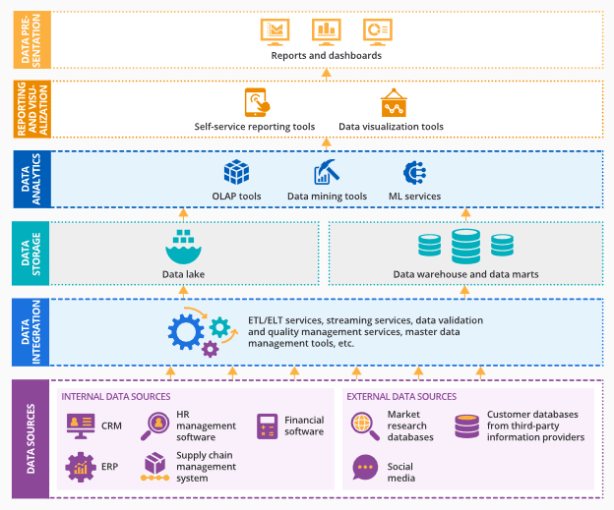
Fintech and data architecture are closely intertwined, as data architecture forms the foundation for the successful implementation and operation of fintech solutions. Data architecture plays a crucial role in the fintech industry, where large volumes of financial data are generated, processed, and analyzed on a regular basis. Fintech companies leverage data architecture to effectively manage and utilize financial information for various purposes such as risk assessment, fraud detection, customer insights, and decision-making. Data architecture in fintech is primarily concerned with managing, storing, processing, and analysing financial data. A modern tech stack typically involves at least a frontend and backend but relatively quickly also grows to include a data platform. This typically grows out of the need for ad-hoc analysis and reporting. Data architecture in fintech typically involves the following components:

Data Sources: Fintech companies gather data from various sources such as banking transactions, credit card purchases, investment portfolios, market data, social media, and more. These diverse data sources contribute to a comprehensive view of customers’ financial activities.

Data Integration: Integrating data from different sources is a critical aspect of data architecture in fintech. It involves consolidating and harmonizing data to create a unified view of financial information. Data integration enables accurate and efficient analysis by eliminating data silos and providing a holistic perspective.

Data Storage: Fintech companies need robust data storage systems to store and manage large volumes of financial data. Traditional relational databases are commonly used, but with the advent of big data technologies, NoSQL databases, data lakes, and cloud storage platforms are also employed to handle the scalability and flexibility requirements.

Data Processing: Fintech companies employ data processing techniques such as data transformation, cleansing, aggregation, and enrichment to ensure the data is accurate, reliable, and suitable for analysis. This step often involves data pipelines and ETL (Extract, Transform, Load) processes to move and process data efficiently.

Data Analytics: Fintech companies rely on data analytics to derive valuable insights from financial data. Advanced analytics techniques such as machine learning, artificial intelligence, and predictive modeling are employed to detect patterns, identify anomalies, make predictions, and generate actionable recommendations.

Data-driven Decision Making: Fintech companies heavily rely on data to make informed business decisions. Data architecture enables the collection, integration, and storage of relevant financial data, allowing fintech companies to analyze trends, patterns, and customer behavior to drive strategic decision-making.

Real-time Data Processing: Many fintech applications require real-time data processing capabilities to deliver up-to-date financial information and enable instant transactions. Data architecture plays a crucial role in designing and implementing systems that can handle real-time data streams, process them efficiently, and provide timely insights and responses.

Personalized Customer Experiences: Fintech companies often aim to provide personalized services tailored to individual customer needs. Data architecture allows for the collection and analysis of customer data, enabling fintech platforms to deliver personalized recommendations, targeted marketing campaigns, and customized financial products.

Data Governance and Security: Fintech companies deal with sensitive financial information, making data governance and security critical. Data architecture includes implementing measures to ensure data privacy, comply with regulations (e.g., GDPR, PCI-DSS), establish data quality standards, and enforce access controls to protect against unauthorized access and data breaches.

Scalability and Performance: Fintech companies must design data architecture that can scale to handle increasing data volumes and support real-time processing requirements. Technologies like distributed computing, parallel processing, and cloud infrastructure are often used to achieve scalability and high-performance data processing.

Data architecture is a critical component of fintech, enabling efficient data management, processing, and analysis. It empowers fintech companies to deliver innovative financial solutions, enhance customer experiences, mitigate risks, and comply with regulatory requirements. A well-designed data architecture forms the backbone of successful fintech operations and enables fintech companies to harness the power of data, improve operational efficiency, enhance customer experiences, and gain a competitive edge in the rapidly evolving financial industry.

Nowadays, Big data adoption is increasing rapidly across all sizes of organizations, however, the method and distinction between obtaining Business Intelligence (BI) and employing Data Analytics (DA) to make actual business decisions with an impact are getting lost in translation. While both terms are used interchangeably, BI and DA are essentially distinct in many ways.
As per some people, there is a distinction between the two by claiming that, while DA employs data science approaches to predict what will or should occur in the future, while BI looks backwards at historical data to describe things that have transpired.
There are differences between DA vs BI, although business intelligence is the more inclusive term that includes analytics. BI assists individuals in making decisions based on historical data, whereas data analytics is more focused on future predictions and trends.
Data analytics is the process of examining databases to find trends and insights that are then applied to decision-making within organizations. Business analytics is concerned with examining various forms of data in order to create useful, data-driven business choices and then putting those conclusions into practice. Insights from data analysis are frequently used in business analytics to pinpoint issues and come up with remedies.  Most businesses make the mistake of trying to implement new technology too quickly throughout their entire business without a strategy in place for how they will really use the tools to address a specific problem.
The process of gathering and studying unprocessed data to make inferences about it is known as data analytics. Every organization gathers enormous amounts of data, whether it is transactional data, market research including ethnographic research, or sales data. The true value of data analysis resides in its capacity to spot trends, hazards, or opportunities in a dataset by identifying patterns in the data. Businesses can change their procedures based on these insights and use data analytics to make better decisions.
BI is the process of iteratively examining an organization’s data with an emphasis on using statistical analysis tools to uncover the knowledge that can support innovation and financial performance. Business analytics enables analytics-driven firms to get the most value from this wealth of insights. They can treat big data as a valuable corporate asset that powers business planning and underpins long-term goals. Business analytics can be classified as either descriptive, predictive, or prescriptive. These are typically deployed in phases and, when combined, can address or resolve almost any issue that a business may have.

Techniques Used In DA

To expedite the analytical process, the majority of widely used data analysis procedures have been automated. Data analysts may now quickly and efficiently sort through massive volumes of data using the following methods rather than spending days or weeks doing so. They are described as follows:

  • Data mining is the process of searching through big data sets to find patterns, trends, and connections.
  • In order to assist firms to respond effectively to future outcomes like customer performance, predictive analytics aggregates and analyses previous data.
  • Machine learning teaches computers to process data more quickly than traditional analytical modelling by using statistical probability.
  • Utilizes machine learning, predictive analytics, and data mining techniques to turn raw data into actionable business knowledge.
  • Documents, emails, and other text-based content can be mined for patterns and moods using text mining.

Techniques Used In BI

BI techniques can be classified as either descriptive, predictive, or prescriptive. These are typically deployed in phases and, when combined, can address, or resolve almost any issue that a business may have. They are described as follows:

  • Descriptive analytics parses historical data to gain knowledge on how to make future plans. Executives and non-technical professionals can benefit from the insights produced by big data to improve business performance because self-service data access, discovery, and dashboard technologies are widely available.
  • Predictive analytics is the subsequent stage on the road to insight to assist organizations in forecasting the possibility of future events, machine learning and statistical techniques are used. Predictive analytics can only indicate the most likely conclusion based on the past because it is probabilistic in nature and cannot foretell the future.
  • Prescriptive analytics investigates potential courses of action based on the findings of descriptive and predictive analysis. This kind of analytics mixes business rules with mathematical models to offer many viable answers to various tradeoffs and scenarios to improve decision-making.

Data-driven Culture

Posted: January 4, 2023 by Virendra Yaduvanshi in Database Administrator
Tags: , , ,

Data Culture is a passport you need to survive in this new digital world, where decisions are driven by data rather than solely on assumptions and past experiences.
Data culture is a journey, where we need to constantly keep working on it, and it will keep on improving. Data is all around us. It is in the form of numbers, spreadsheets, databases, pictures, videos, and many other things. Organisations are now using data and leveraging it to derive impact and growth. Data is the backbone, and a data-driven culture is critical for organisations to survive and expand.  A data-driven culture is about replacing the gut feeling to make decisions with facts and assumptions. A company is said to have a data-driven culture when people are clear about the driver metrics they are responsible for and how those metrics move the Key Performance Indicators – KPIs. There needs to be data democratization, i.e., the information is accessible to the average user. The company needs its employees to understand and use 
data to make decisions based on their roles. It needs citizen analysts, who can do simpler analytics, and are not dependent on the data team for it. The company also needs a Single Source of Truth—when the employees/stakeholders make decisions based on the same data set. It needs to have data governance and Master Data Management in place to maintain uniformity, accuracy, usability, and security of data.

At the very top level, there are four components of data-driven culture—Data Maturity, Data-Driven Leadership, Data Literacy, and Decision-making Process. These 4Ds are essential when building a data-driven culture.

Data Maturity

Data maturity is foundational to data culture. It deals with the raw material, i.e. data, and its management. An organization with good data maturity has high standard data of quality and checks in place to maintain it. For a good level of data maturity, it is important to have metadata management in place and ensure that it is aligned with the KPIs. Similarly, it is necessary to record Data Lineage, which helps in understanding what happened to it since its origin. Other factors that affect data maturity are usability, ease of access, and scalable and agile infrastructure. For example, if a company has an archaic infrastructure in place, it will take too long to access data. In such scenarios, the organization will not use data that is not easily accessible. Further, companies would spend most of their time validating and building alignment rather than on the impact if there is no alignment of the KPIs.

Data-Driven Leadership

Leaders define the culture of any organization. To establish a data culture, leaders must step up and lead by example. A data driven leader asks the right questions and holds his/her teams responsible to ensure that data is being used and a structured process is followed. A data-driven leader sees data as a strategic asset and makes “think and act data” a key strategic priority.

Data Literacy

Companies with a higher data literacy tend to use data to understand their customers better as well as how they use the product. Data literacy is the ability to read, use, digest, and interpret data toward meaningful discussion and conclusion. For an organization, data literacy does not mean that employees have an excellent understanding of using and interpreting data. It calls for everyone to have a certain level of data literacy depending upon their job role and the decisions they need to make. However, it also calls for ensuring that there is no data sceptic.

Decision-making Process

Data needs to be an integral part of that decision-making process to get the most value out of it. Is there a planning mechanism in place to choose between projects to work on or if there is a lookback mechanism to review the decisions? Most organisations do not have a systematic, data-driven decision-making process.

Using facts and evidence in the workplace is a good way to guide a company’s decisions and track outcomes. When everyone within an organisation incorporates data and information in their day-to-day activities, they develop a culture that emphasizes and prioritizes data analysis. Cultivating a data-driven culture in our workplace can improve outcomes across the organization and ensures a strategic plan for achieving goals.